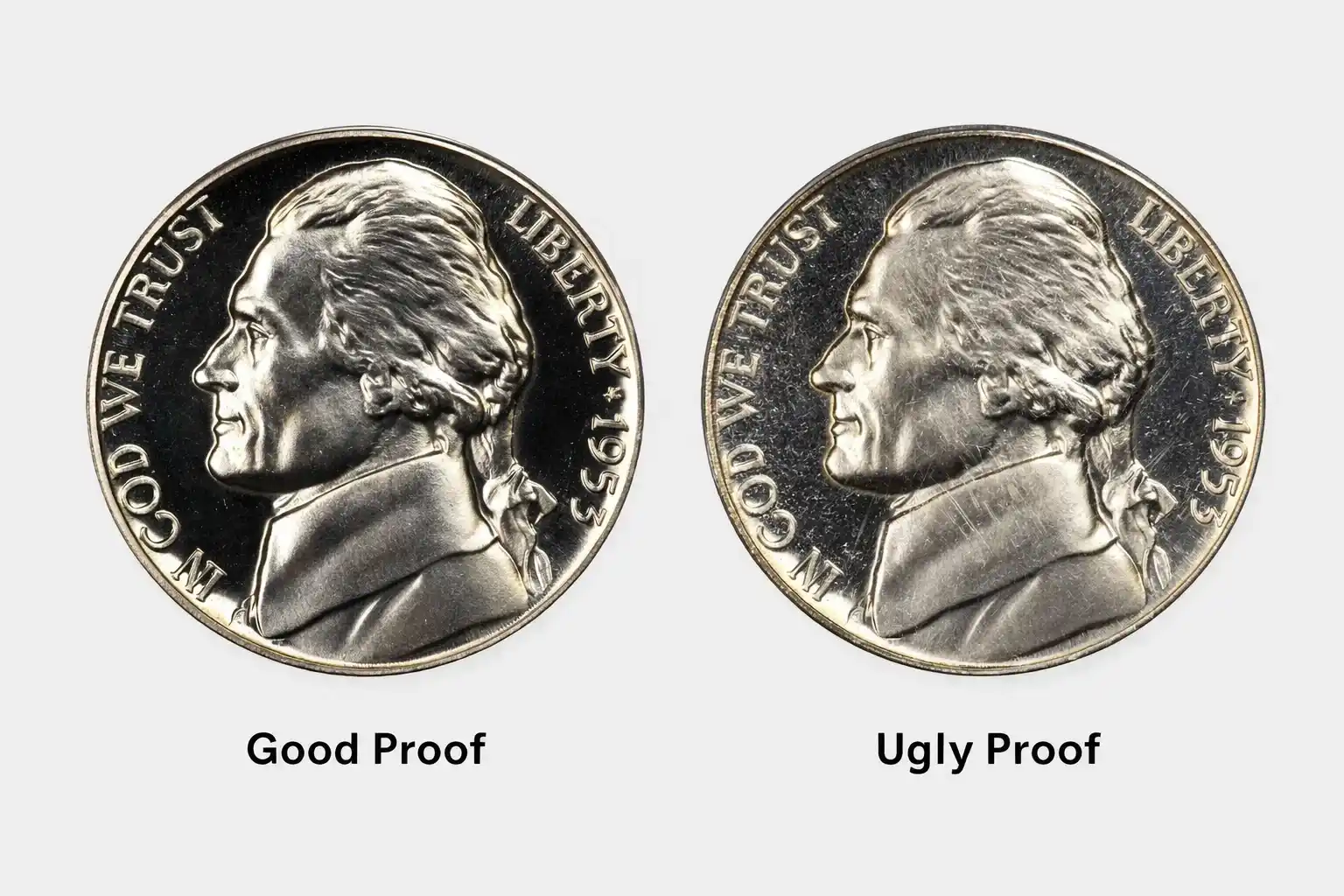
A 1953 nickel proof can look sharp at first glance. It can also disappoint the moment you tilt it under the light. That is the main issue with this date in proof format. The coin sounds better than it often looks. Many pieces survive. Not all survive well. Some have weak eye appeal, dull fields, or surface trouble that cuts collector interest fast.
This is why the proof version needs a separate look. A regular business strike and a proof nickel do not follow the same visual rules. On a proof, the fields show more. Good surfaces look cleaner. Bad surfaces look worse. A small flaw becomes easier to spot. For that reason, buying a 1953 proof nickel without checking the surface closely is a mistake.
What Was Issued in 1953
Before discussing proof quality, it helps to separate the 1953 issues.
| Issue | Mint Mark | Type | Intended Use | Main Things to Check |
| 1953 | None | Business Strike | Circulation | Luster, marks, strike |
| 1953-D | D | Business Strike | Circulation | Strike, detail, surfaces |
| 1953-S | S | Business Strike | Circulation | Sharpness, wear, appeal |
| 1953 Proof | None | Proof | Collectors | Mirrors, haze, hairlines, spots |
The first three were circulation coins. They entered daily commerce and saw normal use. The proof issue was made for collectors. It was struck with more care and should show cleaner fields and a stronger finish. That does not mean every surviving proof still looks good today. Storage, handling, and surface changes matter more than the date alone.
What a Good Proof Should Look Like
A strong proof nickel has a certain look. It should feel deliberate. The fields should reflect light cleanly. The design should stand out against that surface. The coin does not need to be perfect to be attractive, but it should not look tired.
A solid proof usually shows:
- Clear mirrors
- Clean fields
- Sharp devices
- Balanced contrast
- Limited distractions
The key point is simple. A proof should look more refined than a normal strike. If it looks cloudy, flat, or messy, the format has lost much of its appeal.
The Main Problem With Ugly Proofs
The weak proofs from 1953 usually fail in the same places. Some show one issue. Others show several at once. Once that happens, the coin stops looking like a collector’s piece and starts looking like a compromised one.
Haze
Haze is one of the most common problems. It appears as a cloudy layer over the fields. Sometimes it is light. Sometimes it covers much of the coin. On a proof, haze kills the mirrors first. The surface no longer looks crisp. It looks muted.
Hairlines
Hairlines are thin lines on the surface. They often come from wiping, light rubbing, or poor handling. They may look minor in a photo. Under angled light, they can become the first thing you see. Proof coins are especially sensitive to this. The polished fields reveal these lines fast.
Spots and Stains
Dark spots, stains, and small areas of uneven color break the visual balance. A proof nickel does not need bright color to work well, but it does need a stable and coherent surface. Random marks reduce that effect. A spotted proof often looks worse than a lightly toned one.
Dull Mirrors
Some proof nickels still show detail, but lose the strong reflective look that collectors expect. The fields may appear dead or uneven. The coin is still a proof by method of manufacture, but it no longer gives the visual response that buyers want.
Fingerprints and Handling Marks
These problems are easy to create and hard to ignore. A fingerprint on a proof field draws the eye immediately. So do scattered contact marks. Business strikes can absorb this better. Proofs cannot.
Ugly Proof or Normal Aging?
Not every old proof is ugly. Age alone is not the problem. A coin can tone softly and still remain attractive. It can show mild change and keep good mirrors. The real problem starts when the surface looks disturbed, hazy, or lifeless.
That distinction matters. Many collectors confuse all surface change with damage. That is too simple. A lightly toned proof with clean mirrors can still look strong. A bright coin with heavy hairlines can look much worse. The question is not just color. The question is surface quality.
Why This Changes Coin Value
The market does not reward the word “proof” by itself. It rewards the quality of the actual coin. That is where coin value begins to separate. Two 1953 proof nickels can share the same date and type, yet sell very differently. One looks clean and fresh. The other looks cloudy and overhandled. The second coin loses demand even if it is technically the same issue.
This is especially true with collector material that survives in decent numbers. When supply is available, buyers become selective. They do not need to settle for a weak-looking piece unless the price is low enough to justify it.
The pattern is practical:
| Surface Issue | Visual Effect | Market Result |
| Light Haze | Mild softness | Small discount |
| Heavy Haze | Cloudy fields | Clear discount |
| Fine Hairlines | Visible disturbance | Buyer hesitation |
| Heavy Hairlines | Strong surface damage | Major appeal loss |
| Spots Or Prints | Distracting look | Harder sale |
This is why surface review matters more than many new buyers think. A proof nickel is not valuable because it was made for collectors. It is valuable when it still looks like one.
How to Inspect a Raw Proof Before Buying
Raw proof nickels need slow viewing. This does not require expensive equipment. Good light and the right angle are enough to catch most problems.
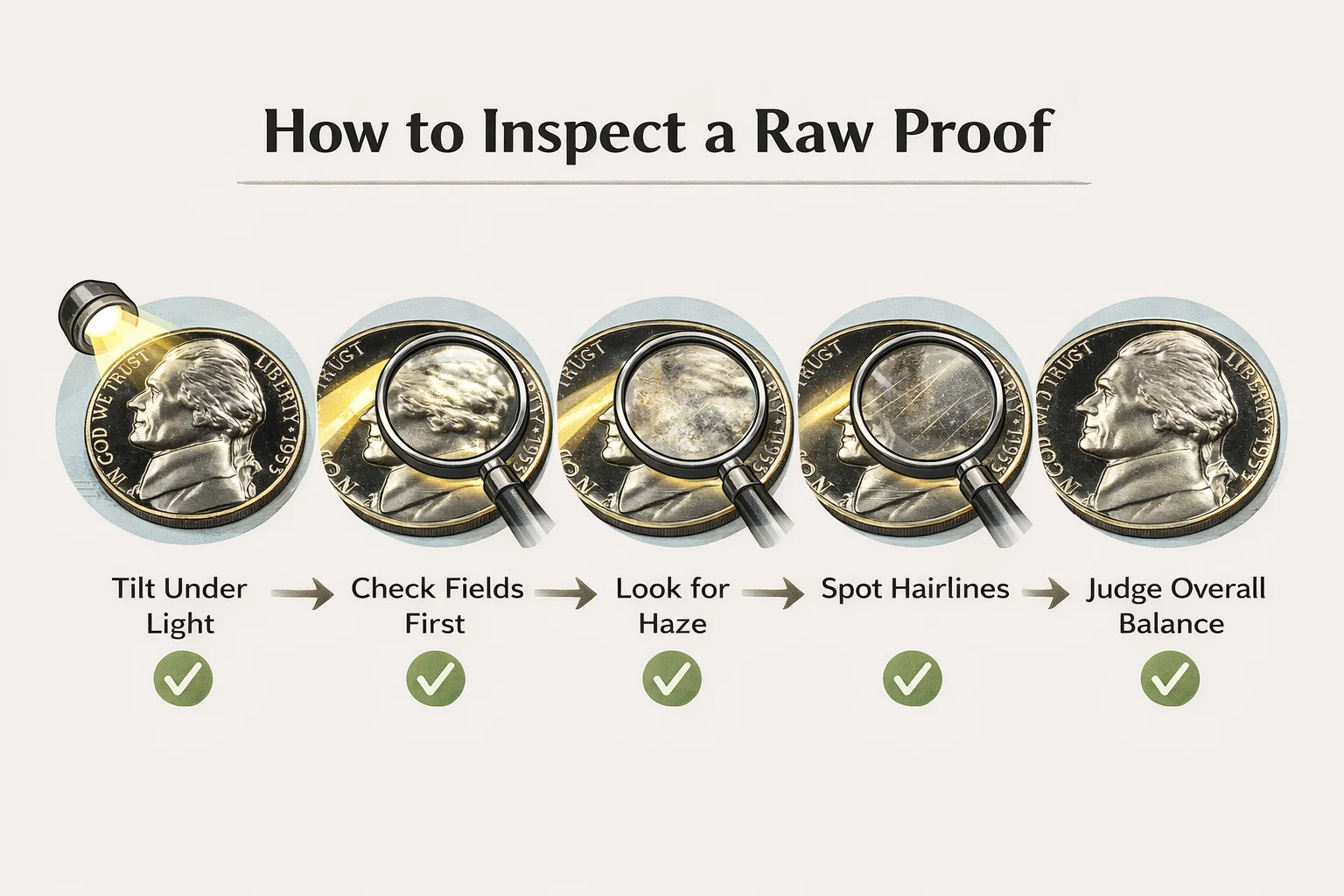
Check the coin in this order:
- Tilt the coin under the light
- Study the fields first
- Look for cloudy areas
- Check for fine lines
- Review the overall balance
Start with the open fields, not the portrait. That is where the proof weakness shows first. Then move to the design and see whether the surfaces stay consistent across the coin. If one side looks much weaker than the other, ask why.
A good proof usually feels stable. A weak one feels uneven. That first impression often tells the truth.
Online Photos Can Hide the Problem
Buying from photos creates another risk. Haze can disappear under bright light. Hairlines can vanish in soft focus. Dark images can hide surface trouble. Front-facing shots often tell less than angled ones.
This is why online proof purchases require caution. A seller may not be hiding anything. The image still may not show what matters. For a proof coin, poor photography changes the whole reading.
Useful images should show:
- Angled light
- Close surface detail
- Both sides clearly
- Honest reflection in the fields
Flat or overly bright photos are less helpful. On a proof nickel, the surface is the story.
Smart Tools to Get Help
The reliable coin identifier app can help at the start, but not at the finish. It can confirm the date, type, and basic issue. It can help separate a proof nickel from a business strike in a mixed group. That is useful when you sort old sets, loose coins, or inherited material.
Coin ID Scanner fits that early stage well. Its smart filters and large coin database (more than 187,000 coins) help narrow the issue fast and keep similar pieces from being mixed together. That said, no app can fully judge haze, hairlines, mirror strength, or eye appeal from the way a collector can under direct light. Surface quality still needs human review.
When an Ugly Proof Still Makes Sense
Not every weak proof should be rejected. Some still make sense as low-cost placeholders. Some are acceptable if the problem is small and the price reflects it. A budget collector may prefer a decent but imperfect example over waiting too long for a better one.
That choice depends on the goal. A set builder may accept a light haze issue. A stricter collector may pass and wait for stronger mirrors. The coin is not automatically bad because it has one flaw. It becomes less useful when the flaws dominate the look.
Final Check
The 1953 proof nickel is not difficult to find. The hard part is finding one that still looks right. That is the real lesson of this issue. The date is common enough. Surface quality is what separates a pleasing proof from a weak one.
Look at the fields first. Check the mirrors. Watch for haze, lines, prints, and dead areas. A proof should look controlled and clean. If it looks dull, messy, or flat, the label does not save it. On a 1953 nickel, appearance does more work than the word “proof.”